
How decaffeinated coffee is produced is a common question amongst those who wish to enjoy the flavour of coffee whilst avoiding the stimulating effects of caffeine. Although caffeine is a natural component of the coffee bean, there are various methods capable of removing it almost entirely without significantly altering the sensory profile of the drink.
Nowadays, the process for producing decaffeinated coffee is based on techniques designed to remove the caffeine from the green bean before roasting, whilst preserving the compounds responsible for the coffee’s aroma, flavour and body. These methods have evolved considerably since the first experiments carried out in the 19th century.
Understanding how the decaffeination process works provides a better insight into the complexity behind a product that is now a regular feature of the range offered by many coffee shops and roasters.
What is decaffeinated coffee?
Decaffeinated coffee is coffee from which most of the caffeine naturally present in the bean has been removed. Caffeine is one of the more than four hundred chemical compounds that make up coffee and is responsible for its well-known stimulating effect.
The aim of decaffeination is not to remove the caffeine completely, but to reduce its content to minimal levels. In the European Union, decaffeinated coffee must contain less than 0.1 percent caffeine in the green coffee beans.
The difficulty of the process lies in the fact that caffeine is integrated into the structure of the bean. Therefore, decaffeination methods must act selectively, extracting this compound without removing other soluble elements that influence the flavour of the coffee.
The origin of decaffeinated coffee
The interest in discovering how to produce decaffeinated coffee began in the 19th century. In 1820, the German chemist Friedlieb Ferdinand Runge identified caffeine as one of the compounds present in coffee, which paved the way for research into its removal.
The first significant commercial breakthrough came at the start of the 20th century. The entrepreneur Ludwig Roselius founded the German company Kaffee HAG and developed one of the first industrial methods for producing decaffeinated coffee. His technique involved moistening the green coffee beans to increase their porosity and then applying a solvent to extract the caffeine.
Since then, decaffeination methods have evolved with the aim of improving the efficiency of the process and better preserving the sensory qualities of the coffee.
Methods for producing decaffeinated coffee
There are currently several methods used to produce decaffeinated coffee. Although each employs different techniques, they all share one key characteristic: the caffeine is always removed from the green coffee beans before they are roasted.
The three most widely used methods in the industry are solvent-based decaffeination, carbon dioxide decaffeination and water-based decaffeination.
Solvent-based decaffeination process
This method is based on the use of substances capable of selectively dissolving caffeine. The most commonly used solvents are methylene chloride and ethyl acetate.
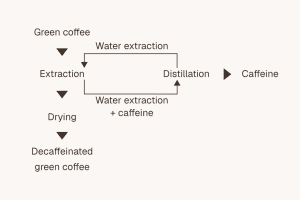
The process begins by hydrating the green coffee beans using water or steam. This step increases the size of the bean and helps to open its pores. Once the coffee has been prepared, the solvent is added, which dissolves the caffeine present in the beans.
The solvent, now laden with caffeine, is then separated from the coffee and undergoes a distillation process that recovers the solvent and removes the extracted caffeine. This cycle can be repeated several times until the desired level of decaffeination is achieved.
Finally, the coffee is exposed to steam to remove any residual solvent before the beans are dried.
 Carbon dioxide decaffeination process
 Carbon dioxide decaffeination process
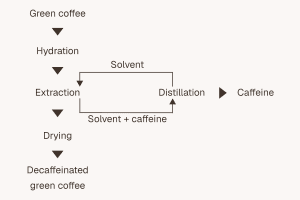
The carbon dioxide decaffeination process uses CO₂ in a supercritical state. Under these conditions, carbon dioxide exhibits properties that are intermediate between those of a gas and a liquid, enabling it to act as a selective solvent.
In this process, the pre-hydrated coffee is placed in a high-pressure vessel. Supercritical carbon dioxide is then circulated through the beans. This fluid extracts the caffeine from the coffee without removing other compounds that are important for flavour.
Once the CO₂ has absorbed the caffeine, it is directed to another vessel where the caffeine is separated using adsorbents or pressure changes. The carbon dioxide can be reused in further extraction cycles.
This method is particularly valued because it preserves much of the coffee’s aromatic characteristics.
Water-based decaffeination process
 Water-based decaffeination process
Water-based decaffeination is one of the most highly regarded methods in the speciality coffee market. This method removes caffeine using only water and carbon filters.
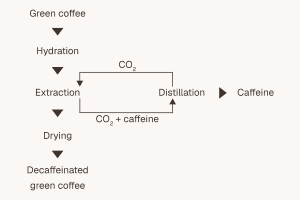
The process begins by immersing the green coffee beans in hot water to extract all the soluble compounds from the coffee, including caffeine. This extract is then passed through carbon filters, which retain only the caffeine.
The resulting liquid, which contains all the soluble components of the coffee except caffeine, is reused to treat new beans. As it is saturated with the coffee’s aromatic compounds, the only substance extracted from the beans during the process is caffeine.
This system removes up to 99 percent of the caffeine whilst largely preserving the coffee’s original flavour profile.
How does decaffeinated coffee retain its flavour?
 How does decaffeinated coffee retain its flavour?
One of the greatest challenges in studying how decaffeinated coffee is produced is preserving the characteristic aroma and flavour of the original coffee. During the decaffeination process, there is a risk that some aromatic compounds may be lost along with the caffeine.
For this reason, modern methods aim to act selectively, removing only the caffeine whilst keeping the compounds responsible for the coffee’s sensory profile intact.
Thanks to technological advances, today’s decaffeinated coffee offers results that are increasingly close to those of conventional coffee. This has enabled many roasters and industry professionals to include high-quality decaffeinated coffees in their range.
The development of new techniques and the growing demand for this type of coffee suggest that decaffeinated coffee production processes will continue to evolve in the coming years, with the aim of further improving its quality and preserving the characteristics of the original coffee as much as possible.